- Your cart is empty
- Continue Shopping

Uncategorized
Borehole Water Treatment in Tanzania: Complete Guide to Purification, Filtration and Safe Drinking Water
-
By admin
- Posted on
- 0 comments
Borehole Water Treatment in Tanzania | Borehole Water Purification | Salty Water Treatment | Reverse Osmosis (RO) | Industrial Water Filtration
Borehole water is an important source of water for homes, apartments, hotels, safari lodges, schools, hospitals, commercial buildings and industrial facilities throughout Tanzania. However, water that appears clear when pumped from underground is not necessarily safe for drinking, cooking, bathing or industrial use.
High salinity, excessive hardness, iron, manganese, suspended sediments, unpleasant odours and microbiological contamination can affect borehole water quality. Without appropriate treatment, these issues may contribute to scaling, equipment damage, unpleasant water characteristics, operational challenges and potential health risks.
Whether you operate a residential property in Dar es Salaam, a hotel in Zanzibar, a safari lodge in Serengeti, a school in Dodoma or a manufacturing facility in Tanzania, selecting the right borehole water treatment system starts with understanding your raw-water quality and daily water requirements.
BILLAFRICA INTERNATIONAL INVESTMENTS LIMITED provides engineered water-treatment solutions designed around water analysis, source conditions, treatment capacity, intended application and long-term operational needs.
From multimedia filtration, activated carbon filtration and water softening to ultrafiltration (UF), ultraviolet (UV) disinfection and reverse osmosis (RO), the appropriate treatment combination can help transform challenging raw water into water suitable for its intended purpose, subject to verification through appropriate testing.
Need a borehole water treatment solution in Tanzania? Contact BILLAFRICA through www.billafrica.com to discuss your water quality, treatment requirements and project specifications.
1. What Is Borehole Water Treatment?
Borehole water treatment is the process of removing, reducing or controlling unwanted physical, chemical and microbiological contaminants in underground water to make it suitable for a specific application.
Water is extracted from an underground aquifer through a drilled borehole and pumped into a storage or treatment system. Its quality depends on geological formations, aquifer conditions, nearby activities, borehole construction, water-table characteristics and other environmental factors.
Borehole water treatment may involve several processes, including:
- Sediment filtration: Removes suspended particles such as sand, silt, rust and other sediments.
- Multimedia filtration: Reduces suspended solids and turbidity through filtration media such as graded sand and other suitable materials.
- Activated carbon filtration: Reduces certain organic compounds, chlorine where present, and some compounds responsible for taste and odour.
- Water softening: Reduces calcium and magnesium hardness through ion exchange.
- Ultrafiltration (UF): Removes suspended particles and many microorganisms through a membrane barrier, depending on membrane integrity and system design.
- Reverse osmosis (RO): Reduces dissolved salts and a wide range of dissolved contaminants through a semipermeable membrane.
- Ultraviolet (UV) disinfection: Inactivates susceptible microorganisms when the system is correctly sized, maintained and operated.
- Chemical treatment: May include oxidation, pH adjustment, coagulation or disinfection where justified by the water analysis.
Not every borehole requires all these processes. A correctly engineered system uses only the treatment stages needed to address the identified water-quality problems and meet the intended water-use requirements.
2. Common Borehole Water Problems in Tanzania
Borehole water quality varies significantly between regions and even between neighbouring boreholes. The most reliable way to determine the appropriate treatment process is to obtain a representative water sample and have it tested by a suitable laboratory.
High TDS and salty borehole water
Total dissolved solids (TDS) represent the combined concentration of dissolved substances in water, generally expressed in milligrams per litre (mg/L) or parts per million (ppm).
High TDS may be associated with elevated concentrations of dissolved salts such as sodium, chloride, calcium, magnesium and sulphates. Saline or brackish groundwater can occur in coastal and other geological environments.
Common signs may include:
- Salty or unpleasant taste.
- White mineral deposits on plumbing fixtures.
- Corrosion concerns, depending on the water chemistry.
- Unsuitable water characteristics for certain industrial processes.
A high TDS reading alone does not identify which dissolved substances are present or establish whether the water is safe or unsafe to drink.
Recommended treatment: Reverse osmosis may be suitable for reducing dissolved salts, but system selection should be based on laboratory results, water recovery requirements, membrane compatibility and the intended application. Pretreatment may be required to control hardness, iron, manganese, turbidity or other membrane-fouling risks.
Hard borehole water
Hard water contains elevated concentrations of dissolved calcium and magnesium.
Potential problems include:
- Scale formation in pipes and plumbing fixtures.
- Mineral deposits on heating elements and boilers.
- Reduced efficiency of some heat-transfer equipment.
- Increased soap and detergent consumption in some applications.
- Scaling within RO membranes and other equipment.
Recommended treatment: An appropriately sized ion-exchange water softener may be used to reduce hardness. In some installations, antiscalant dosing, pH adjustment or other pretreatment may be required instead, depending on the system design.
Iron and manganese contamination
Iron and manganese occur naturally in some groundwater sources. Depending on their chemical form and concentration, they may cause:
- Yellow, reddish-brown or black staining.
- Metallic taste or discolouration.
- Deposits in pipes, storage tanks and filtration equipment.
- Fouling of downstream membranes.
- Problems with laundry and sanitation.
Recommended treatment: Depending on the concentration and oxidation state, treatment may involve aeration or chemical oxidation followed by suitable media filtration. The design should account for pH, oxidation requirements, filter loading, backwashing and disposal of the resulting wastewater.
Muddy, sandy and turbid borehole water
Borehole water may contain suspended particles from aquifer conditions, poor borehole development, damaged infrastructure or other causes.
High turbidity can interfere with disinfection and increase fouling of downstream equipment.
Recommended treatment: Sediment filtration, multimedia filtration or other suitable clarification processes can reduce suspended solids. The filtration stages should be selected according to particle characteristics, turbidity and flow requirements.
Unpleasant smell and taste
Some boreholes may have a noticeable earthy, musty, sulphurous or other unpleasant odour.
These characteristics can have several causes, including naturally occurring compounds, dissolved gases, organic matter or microbiological activity.
Recommended treatment: Activated carbon, aeration, oxidation or other specific treatment processes may be appropriate, depending on the substance responsible. Identifying the cause is essential before selecting equipment.
Microbiological contamination
Borehole water can be contaminated by bacteria, viruses, protozoa or other microorganisms due to aquifer conditions, poor borehole construction, damaged wellheads, nearby sanitation systems or contaminated storage.
Clear water is not proof of microbiological safety.
Recommended treatment: A suitable disinfection barrier may include chlorination, UV disinfection or a validated membrane-based process. Selection depends on the contaminants, flow rate, water clarity, storage conditions and required microbial performance. Disinfection and safe storage practices must be considered together.
3. Why Borehole Water Testing Is Essential Before Installation
One of the most important steps in designing a borehole water purification system is conducting a water-quality assessment.
Installing a treatment plant without knowing the characteristics of the raw water can result in inappropriate equipment selection, unnecessary capital expenditure, premature membrane fouling, excessive operating costs or failure to achieve the required water quality.
A comprehensive analysis may include:
| Parameter | What it indicates | Engineering relevance |
|---|---|---|
| TDS | Total dissolved substances | Helps assess the need for desalination |
| pH | Acidity or alkalinity | Influences corrosion, scaling and treatment |
| Turbidity | Water cloudiness | Helps determine pretreatment needs |
| Electrical conductivity | Dissolved ionic content | Supports salinity assessment |
| Total hardness | Calcium and magnesium | Guides softener and antiscalant design |
| Iron | Dissolved or particulate iron | Guides oxidation and filtration |
| Manganese | Dissolved or particulate manganese | Guides specific removal processes |
| Chloride | Chloride concentration | Helps assess salinity and corrosion concerns |
| Sulphate | Sulphate concentration | Supports treatment selection |
| Nitrate | Nitrate concentration | Helps assess chemical water-quality risks |
| Fluoride | Fluoride concentration | Important for drinking-water assessment |
| E. coli | Indicator of faecal contamination | Helps assess microbiological safety |
| Total coliforms | Indicator organisms | Helps assess source and system hygiene |
The exact testing programme should reflect the intended use, local conditions, relevant drinking-water standards and any suspected contaminants.
For drinking-water applications, results should be compared with applicable Tanzanian requirements and relevant internationally recognized guidance.
BILLAFRICA engineering approach: Share your borehole laboratory report with our team so that the treatment configuration, system capacity, pretreatment and disinfection requirements can be assessed against your actual water-quality data.
4. Types of Borehole Water Treatment Systems
The appropriate treatment system depends on the source-water analysis, daily demand, peak flow, treated-water storage, application and operating conditions.
A. Multimedia filtration systems
Multimedia filtration is commonly used to reduce suspended solids and turbidity in borehole water.
A typical configuration may include a pressure vessel containing selected filtration media, such as graded sand, gravel and other media suited to the water characteristics.
The system may incorporate:
- FRP pressure vessels.
- Manual or automatic control valves.
- Suitable media layers.
- Backwashing arrangements.
- Raw-water and treated-water connections.
Multimedia filtration can act as pretreatment before activated carbon, softening, UF or RO, as required by the design.
B. Activated carbon filtration
Activated carbon filtration uses porous carbon media to adsorb certain organic substances and reduce some taste and odour compounds.
A typical installation may include an FRP pressure vessel, activated carbon, appropriate supporting media, control valves and backwashing arrangements.
The performance depends on the contaminant, carbon type, contact time, water chemistry and media condition.
Activated carbon does not reliably remove dissolved salts, hardness or all microbiological contaminants. It should not be treated as a complete drinking-water purification system by itself.
C. Automatic water softening systems
Water softeners generally use cation-exchange resin to exchange calcium and magnesium ions for sodium or another selected ion.
A typical system includes:
- Resin vessel.
- Ion-exchange resin.
- Brine tank.
- Automatic control valve.
- Regeneration and backwash arrangements.
The system periodically regenerates the resin using a suitable brine solution. Regeneration frequency depends on water hardness, daily treated volume, resin capacity and operating conditions.
Softening is useful where hardness control is required, but conventional softening does not remove the majority of dissolved salts or provide comprehensive disinfection.
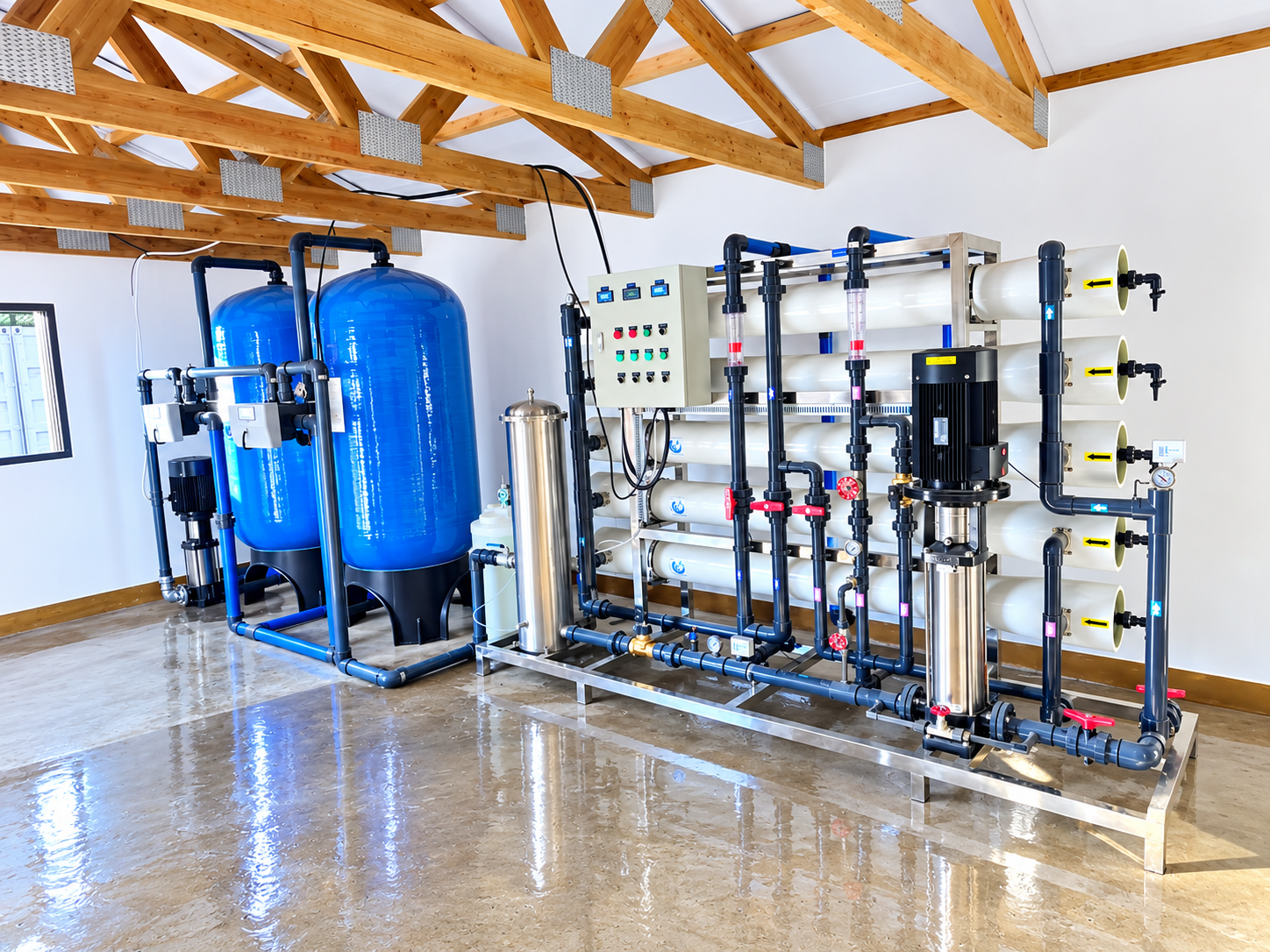
D. Reverse osmosis water treatment plants
Reverse osmosis is a membrane-based treatment technology that uses applied pressure to drive water through a semipermeable membrane, reducing many dissolved salts and contaminants.
A commercial or industrial RO plant may include:
- Raw-water feed pump.
- Pretreatment filtration.
- Water softening or antiscalant dosing, where required.
- Cartridge filtration.
- High-pressure pump.
- RO membrane vessels.
- Control and monitoring instruments.
- Product-water and reject-water connections.
- Storage and post-treatment where required.
BILLAFRICA offers RO solutions across a range of capacities, including 125LPH, 250LPH, 500LPH, 1,000LPH and larger systems, subject to project specifications.
RO systems can be appropriate for high-TDS and brackish borehole water, but the membrane configuration, operating pressure, recovery, pretreatment and product-water quality must be designed for the actual feed-water chemistry.
RO product water may require remineralization, pH adjustment or other post-treatment depending on its intended use.
E. Ultrafiltration membrane systems
Ultrafiltration uses membranes with small pores to retain suspended particles, colloids and many microorganisms.
UF can be useful as a pretreatment or as part of a multi-barrier water-treatment system, depending on the raw-water characteristics and the required water quality.
UF is not a desalination process and generally does not remove dissolved salts such as sodium and chloride.
System design should consider membrane integrity, operating pressure, flux, backwashing, chemical cleaning and disinfection requirements.
F. Ultraviolet disinfection
UV systems use ultraviolet light to inactivate susceptible microorganisms as water passes through the treatment chamber.
Effective operation depends on:
- Suitable UV dose.
- Correct flow rate.
- Adequate UV transmittance.
- Proper pretreatment to control turbidity and particles.
- Lamp condition and maintenance.
- System monitoring and installation.
UV does not remove dissolved salts, hardness or suspended particles, and generally provides no residual disinfectant in downstream storage. Appropriate storage hygiene and, where necessary, a residual disinfectant barrier should be considered.
5. How to Choose the Right Borehole Water Treatment System
Choosing the correct treatment system requires more than comparing equipment prices or selecting a plant based on its rated flow alone.
A professional engineering assessment should consider:
- Raw-water quality: Identify the contaminants and their concentrations through representative laboratory analysis.
- Daily water demand: Estimate the actual daily volume required for drinking, cooking, bathing, laundry, process water or other uses.
- Peak flow requirements: Determine the flow rate required during periods of high consumption.
- Treatment objectives: Define the quality requirements for the final water application.
- Pretreatment: Identify any required sediment removal, oxidation, softening, pH adjustment or other conditioning.
- System capacity: Select suitable equipment based on actual operating hours, feed-water conditions, recovery and demand.
- Storage: Provide adequate raw-water and treated-water storage where required.
- Energy and utilities: Assess power supply, water pressure, chemical availability and drainage.
- Maintenance: Plan for replacement filters, membrane cleaning, resin regeneration, consumables and servicing.
- Verification: Confirm performance through appropriate treated-water testing and ongoing monitoring.
A correctly engineered treatment system should be designed around the complete water-treatment process, not an isolated piece of equipment.
6. Borehole Water Treatment for Different Applications in Tanzania
Residential homes and apartments
Residential systems can be designed to treat borehole water for domestic use, including drinking and cooking where the required treatment and verification are in place.
Depending on the source-water analysis, the solution may combine sediment filtration, activated carbon, softening, RO and disinfection.
Larger residential properties and apartments may require centralized treatment, separate drinking-water treatment and properly sized storage.
Hotels, resorts and safari lodges
Hospitality properties often require consistent water quality across guest rooms, kitchens, laundry facilities, swimming pools and other operations.
A hotel in Zanzibar, a safari camp in Serengeti or a lodge near Ngorongoro may have different raw-water characteristics and demand profiles.
BILLAFRICA can assess:
- Borehole or other raw-water quality.
- Guest and staff water consumption.
- Laundry and kitchen requirements.
- Water heating and scaling concerns.
- Drinking-water requirements.
- Remote-site maintenance and operating needs.
Centralized treatment may be combined with point-of-use treatment for selected applications.
Schools, hospitals and institutions
Institutions require water systems designed around occupancy, daily demand, source-water characteristics, safe storage and operational continuity.
The required treatment process should be verified against applicable standards and the institution’s intended use, with appropriate maintenance, monitoring and disinfection procedures.
Industrial and manufacturing facilities
Industrial water requirements vary significantly between production processes, equipment and final products.
A plant may require pretreatment, softening, RO, UF or a combination of technologies. The system must be designed to meet the process specification and should not assume that drinking-water requirements are identical to industrial process-water requirements.
BILLAFRICA supports the assessment and design of commercial and industrial water treatment solutions tailored to operational requirements.
7. How Much Does Borehole Water Treatment Cost in Tanzania?
The cost of a borehole water treatment system depends on the water-quality problems, treatment capacity, equipment configuration, automation, installation conditions and ongoing operating requirements.
Major cost factors include:
- Raw-water laboratory testing.
- Required pretreatment stages.
- Treatment capacity in litres per hour or litres per day.
- RO membrane and pump specifications, where applicable.
- Filtration vessels, valves and media.
- Stainless-steel tanks and other storage requirements.
- Control panels, sensors and automation.
- Plumbing, electrical work and site preparation.
- Installation, commissioning and performance testing.
- Maintenance, consumables and replacement components.
A small household drinking-water system will generally have different equipment and operating requirements from a centralized hotel or industrial treatment plant.
For a meaningful quotation, provide:
- Your location.
- The source of the raw water.
- Your laboratory water analysis, if available.
- The estimated daily demand.
- Your intended application.
- Any existing pumps, tanks or treatment equipment.
Request a tailored borehole water treatment quotation from BILLAFRICA: www.billafrica.com.
8. Borehole Water Treatment Plant Maintenance
Regular maintenance helps maintain treatment performance, protect equipment and identify problems before they result in major system interruptions.
A maintenance programme may include:
- Inspecting and recording raw-water and treated-water quality.
- Monitoring pressure gauges and differential pressure across filters.
- Backwashing multimedia and carbon filters as specified.
- Checking automatic valves and regeneration cycles.
- Replacing sediment and cartridge filters when required.
- Monitoring RO feed pressure, permeate flow, recovery and salt rejection.
- Inspecting membranes and conducting cleaning when indicated.
- Checking UV lamps, alarms and system operation.
- Inspecting pumps, valves, tanks, electrical connections and pipework.
- Maintaining chemical dosing systems where installed.
- Conducting scheduled microbiological and chemical water testing.
Maintenance frequency depends on raw-water quality, operating hours, equipment specifications and performance trends. A fixed replacement interval should not replace condition-based inspection and manufacturer guidance.
BILLAFRICA can help customers plan suitable servicing, consumable replacement and system-performance reviews according to their equipment and operational needs.
9. Why Professional Water Treatment Engineering Matters
A water-treatment plant is a complete process system. Its performance depends on the correct relationship between source-water quality, pretreatment, treatment technology, hydraulic design, equipment specifications, controls, storage and maintenance.
An incorrectly designed system may experience:
- Premature membrane fouling.
- Excessive scaling.
- Poor filtration performance.
- Inadequate disinfection.
- Unexpected operating costs.
- Inconsistent product-water quality.
- Frequent equipment downtime.
Professional engineering begins with water analysis and a clear definition of the treatment objective. It then translates those requirements into a suitable system configuration, followed by installation, commissioning, performance checks and maintenance planning.
At BILLAFRICA INTERNATIONAL INVESTMENTS LIMITED, our focus is on matching water-treatment technologies to actual customer requirements, rather than applying a single configuration to every water source.
10. Why Choose BILLAFRICA for Borehole Water Treatment in Tanzania?
BILLAFRICA INTERNATIONAL INVESTMENTS LIMITED is a Tanzania-based water-treatment and engineering solutions company serving residential, commercial, hospitality, institutional and industrial customers.
Our water-treatment solutions include:
- Borehole water purification systems.
- Reverse osmosis plants.
- Multimedia filtration systems.
- Activated carbon filtration.
- Automatic water softeners.
- Ultrafiltration membrane systems.
- UV disinfection.
- Commercial and industrial water-treatment solutions.
- Water storage and associated treatment equipment.
- Installation, servicing and maintenance support.
Our approach considers the source-water characteristics, daily demand, intended application, technical requirements and long-term operation of each system.
Whether you require a domestic drinking-water solution, a hotel water-treatment plant, a commercial RO system or a large industrial installation, BILLAFRICA can discuss the project requirements and recommend a suitable engineering assessment.
11. Frequently Asked Questions About Borehole Water Treatment in Tanzania
Is borehole water safe to drink in Tanzania?
Not necessarily. Borehole water can contain microbiological or chemical contaminants even when it looks clear. Laboratory testing and an appropriate treatment system are needed to establish suitability for drinking.
How do I purify salty borehole water?
Reverse osmosis is commonly used to reduce dissolved salts in brackish or saline water. The system must be designed using laboratory results, including TDS, individual dissolved ions, hardness, pH and other parameters that affect membrane performance.
Can a water filter remove all borehole water contaminants?
No single conventional filter removes every type of contaminant. Sediment filters, activated carbon, softeners, UF, RO and disinfection technologies perform different functions. The right combination depends on the actual water analysis.
What is the best water treatment system for borehole water?
There is no single best configuration for all boreholes. The appropriate solution depends on raw-water quality, daily demand, intended use, budget, operating conditions and the required treated-water quality.
Can reverse osmosis remove high TDS from borehole water?
RO can substantially reduce many dissolved salts and other dissolved substances. Actual rejection and recovery depend on membrane selection, feed-water chemistry, operating conditions and maintenance.
Does a water softener make borehole water safe to drink?
A conventional ion-exchange water softener reduces hardness but does not provide comprehensive contaminant removal or disinfection. Additional treatment may be required to meet drinking-water requirements.
How many litres per hour should my borehole water treatment plant produce?
This depends on daily demand, peak flow, available operating hours, storage capacity, process requirements and the selected treatment technology. A demand assessment is necessary to determine a suitable capacity.
Can borehole water be used in hotels and safari lodges?
Yes, provided the water is appropriately treated and verified as suitable for each intended use. Hotel and lodge systems should consider drinking water, laundry, kitchens, guest facilities, equipment protection and ongoing maintenance.
How often should a borehole water treatment plant be serviced?
Service intervals depend on raw-water quality, system design, operating conditions and manufacturer specifications. Performance monitoring should guide backwashing, filter replacement, membrane cleaning and other maintenance activities.
Does BILLAFRICA install borehole water treatment systems in Tanzania?
BILLAFRICA offers water-treatment engineering solutions for residential, commercial, hospitality, institutional and industrial applications in Tanzania. Contact the company to confirm service availability, project requirements and installation arrangements for your location.
12. Get a Borehole Water Treatment Solution Engineered for Your Needs
Your borehole is a valuable water source, but its quality must be understood before the right treatment system can be selected.
Whether you are dealing with salty water, high TDS, hardness, iron, manganese, turbidity or microbiological concerns, a properly designed treatment system can address the identified issues and help deliver water suitable for its intended application.
