- Your cart is empty
- Continue Shopping

 By
Pure Drinking Water for Schools in Tanzania: Commercial Reverse Osmosis (RO) Water Purification Systems for Safe, Reliable and Affordable Drinking Water
Every school is entrusted with more than educating children. It is entrusted with protecting the environment in which they learn, grow and build their future.
Every morning, thousands of students across Tanzania enter classrooms, boarding facilities, laboratories, dining halls and school compounds with one essential need in common: access to drinking water throughout the school day.
For school owners, directors, headteachers, principals and administrators, providing drinking water is not simply another operational responsibility. It is an important part of student welfare, institutional hygiene, infrastructure planning and the confidence parents place in the school.
Yet many educational institutions continue to face challenges associated with untreated borehole water, salty water, high total dissolved solids (TDS), unpleasant taste, sediment, inconsistent external water supplies and the recurring costs of purchasing bottled drinking water.
Imagine managing a boarding school where hundreds of students depend on a consistent supply of drinking water every day. Water must be available during lessons, meals, extracurricular activities and evening study sessions. When supply becomes unreliable, school operations can become more complicated.
This is where properly engineered Reverse Osmosis (RO) water purification systems for schools in Tanzania can provide a practical solution.
At BILLAFRICA INTERNATIONAL INVESTMENTS LIMITED, we design, supply, install and support commercial water-treatment solutions intended to address different water sources, institutional requirements and daily consumption demands.
From compact 125LPH RO water purifiers to high-capacity 1000LPH commercial RO water treatment plants, selecting the appropriate technology can help schools establish a more organised, dependable and sustainable drinking-water infrastructure.
Because a school’s responsibility extends beyond the classroom, the water students drink deserves thoughtful engineering.
Why Drinking Water Quality Matters in Tanzanian Schools
Schools across Tanzania operate under different geographical, environmental and infrastructure conditions. A school in Dar es Salaam may rely on municipal water, while an institution in Dodoma, Singida, Arusha, Mwanza, Morogoro or a rural district may depend on boreholes, groundwater, wells or other local sources.
Each source has its own water-quality characteristics.
Some schools may experience water with elevated dissolved salts, hardness, iron, sediment or unpleasant taste and odour. Others may receive water that varies in quality throughout the year or requires additional treatment before drinking.
For boarding schools, colleges and universities, the challenge is particularly important because water demand continues beyond normal classroom hours.
The expectations of parents and guardians
When parents entrust their children to an educational institution, they expect responsible management of the school’s learning environment, sanitation, food preparation and drinking-water facilities.
A well-planned drinking-water system can contribute to a more organised school environment and demonstrate that student welfare is part of institutional infrastructure planning.
While no treatment system can guarantee the prevention of waterborne diseases, properly selected and validated treatment, combined with hygienic handling and regular testing, can help manage relevant water-quality risks.
Reliable drinking water throughout the school day
A school may have hundreds or thousands of students who require access to drinking water at similar times, particularly during breaks, meals and after physical activities.
An appropriately sized commercial RO water purification system, supported by sufficient storage capacity and well-designed distribution points, can help meet these varying demands.
Reducing dependence on bottled water
Regularly purchasing bottled water can introduce recurring expenditure, delivery coordination, storage requirements and plastic packaging waste.
Producing drinking water on-site may offer an alternative for institutions with suitable water sources, sufficient space, trained operators and a manageable maintenance budget.
The financial value depends on actual consumption, equipment costs, water quality, electricity, maintenance and the price of alternative water supplies.
What Is a Commercial RO Water Purification System?
Reverse Osmosis (RO) is a membrane-based water-treatment process that uses pressure to force water through a semi-permeable membrane. The membrane allows water molecules to pass through while rejecting a substantial proportion of dissolved salts and many other dissolved contaminants.
The treated water passing through the membrane is known as permeate, while the rejected contaminants are concentrated in a separate stream called RO concentrate or reject water.
Commercial RO water purification systems are designed to produce treated water at a specified rate, typically measured in litres per hour (LPH) or US gallons per day (GPD).
For schools, RO technology can be integrated with appropriate pretreatment, hygienic storage, post-treatment and distribution infrastructure to provide a complete drinking-water solution.
The system must be designed around actual raw-water characteristics. A machine that works appropriately with one borehole may require a different pretreatment configuration for another.
Commercial RO Water Purification Systems Available for Schools in Tanzania
BILLAFRICA offers commercial RO system capacities for different institutional applications. The appropriate option depends on daily demand, operating hours, raw-water quality, storage and distribution arrangements.
Comparison of commercial RO capacities
RO system capacity| Approximate rated production| Potential institutional applications
125LPH| 1,000L in 8 hours| Small schools, academies, offices
250LPH| 2,000L in 8 hours| Growing schools, medium-sized institutions
500LPH| 4,000L in 8 hours| Large schools, boarding institutions, colleges
1000LPH| 8,000L in 8 hours| Large campuses, universities, high-demand institutions
400GPD| 1,514L in 24 hours| Small-scale drinking-water applications
600GPD| 2,271L in 24 hours| Smaller institutions, decentralised supply
800GPD| 3,028L in 24 hours| Schools requiring greater daily output
These are theoretical production equivalents calculated from rated capacities. Actual production depends on feed-water temperature, pressure, TDS, membrane condition, recovery rate, pretreatment and other operating conditions. GPD ratings are based on specified test conditions and should not be interpreted as guaranteed field output.
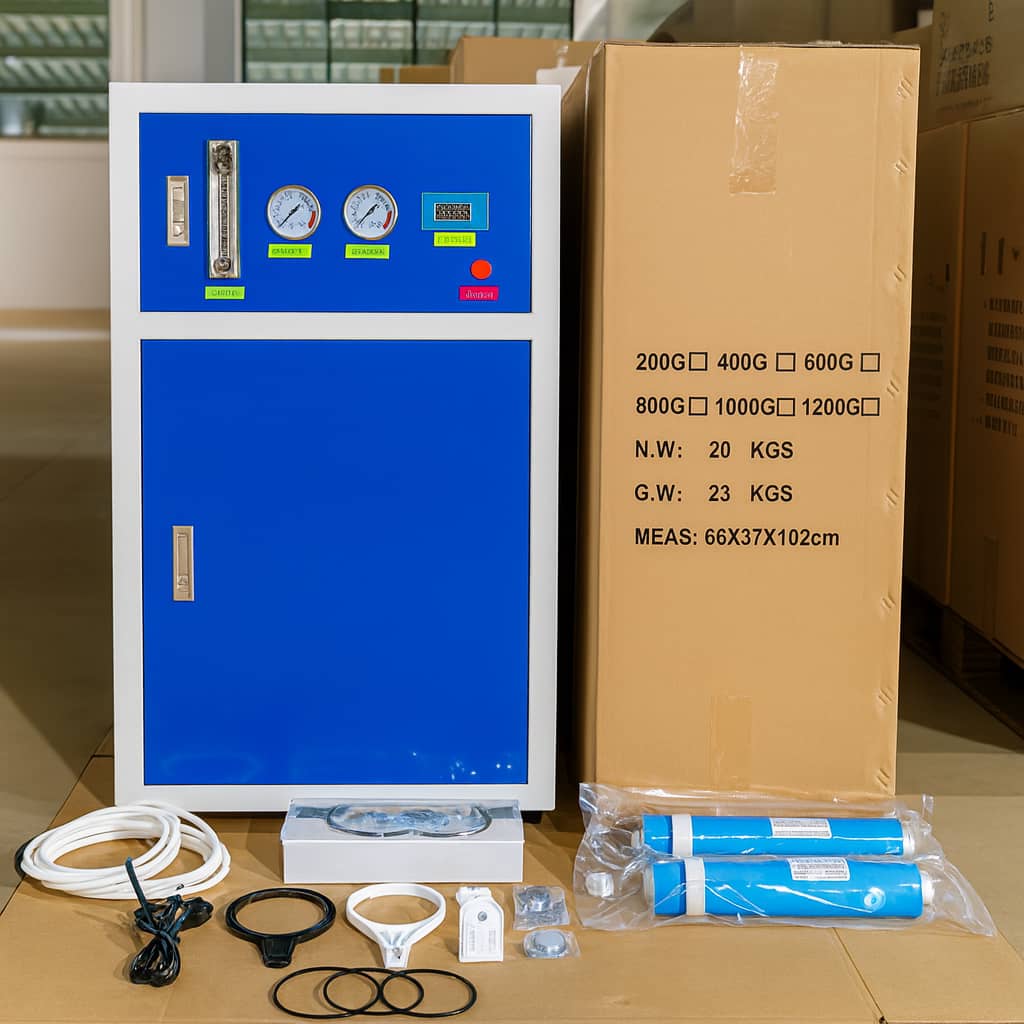
1. 125LPH Reverse Osmosis System for Small and Medium-Sized Schools
A 125LPH commercial RO water purification system can be suitable for smaller private schools, academies, offices and educational institutions with moderate drinking-water requirements.
At its nominal rated capacity, it can produce approximately 1,000 litres over eight hours of operation.
For a school with a relatively small student population, this production rate may support drinking-water requirements when combined with appropriate storage and controlled distribution.
It can also be considered for staff drinking-water facilities, administration blocks and decentralised treatment applications.
However, a boarding school with significant evening and morning demand may need greater production capacity or longer operating hours.
Potential applications:
– Private primary and secondary schools
– Small academies and learning centres
– Staff accommodation facilities
– School administration buildings
– Small educational institutions relying on boreholes
2. 250LPH Commercial RO System for Growing Schools
A 250LPH RO water purification system offers a higher production rate for medium-sized schools and institutions experiencing increasing water demand.
At a nominal eight-hour operating period, it has a theoretical production capacity of 2,000 litres.
When integrated with appropriately sized food-grade storage tanks and hygienic distribution points, it can support centralised drinking-water treatment for multiple school facilities.
For growing institutions, selecting a system with adequate production capacity and allowance for peak demand can help reduce operational pressure.
3. 500LPH Reverse Osmosis Water Plant for Boarding Schools
Boarding schools have distinctive drinking-water requirements because students remain on campus throughout the day and night.
A 500LPH commercial RO water treatment plant can be considered for larger schools, boarding institutions, colleges and educational facilities with substantial daily demand.
At its nominal rating, the system can produce approximately 4,000 litres in eight hours.
Depending on the water source and demand profile, it may be integrated into a centralised water-treatment arrangement with suitable pretreatment, treated-water storage, distribution pipelines and dispensing points.
The actual number of students supported depends on drinking-water consumption per person, additional institutional requirements and the hours available for production.
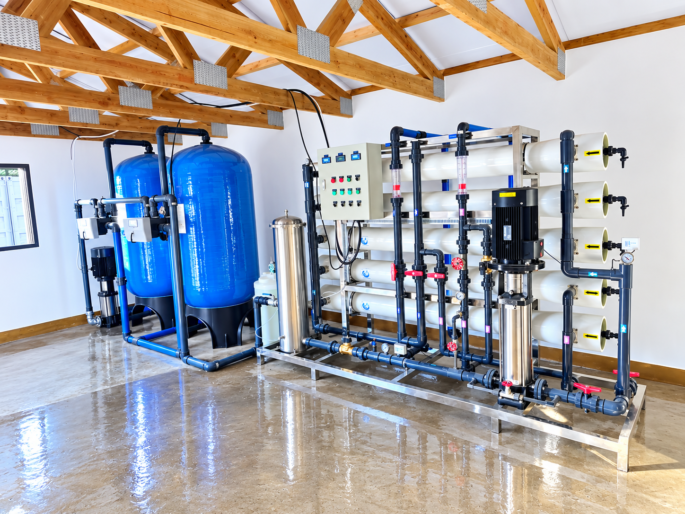
4. 1000LPH Industrial RO Water Purification System for Universities
Large educational campuses often have several academic blocks, staff offices, dining facilities, accommodation buildings and other shared infrastructure.
A 1000LPH industrial RO water purification system can be considered for high-demand institutions, major boarding schools, universities and large educational campuses.
At its rated production rate, it can theoretically produce 8,000 litres over eight hours.
Larger systems require careful planning of pretreatment, pumps, storage tanks, treated-water distribution, electrical infrastructure, operator responsibilities and concentrate disposal.
For large campuses, an engineering assessment may also determine whether one centralised RO plant or several strategically located treatment systems are more appropriate.
5. 400GPD, 600GPD and 800GPD Commercial RO Systems
GPD means US gallons per day. One US gallon is approximately 3.785 litres.
These systems may suit smaller institutions, decentralised drinking-water requirements, staff facilities and other applications where the expected daily production is compatible with the rated output.
– 400GPD RO system: Approximately 1,514 litres per day under specified rated conditions.
– 600GPD RO system: Approximately 2,271 litres per day under specified rated conditions.
– 800GPD RO system: Approximately 3,028 litres per day under specified rated conditions.
These daily equivalents should not be assumed to represent actual production in every installation. Actual output depends on operating conditions and the equipment’s design.
Schools should compare the expected daily demand with the achievable field production rather than selecting a system based on its advertised rating alone.
How to Calculate the Right RO System Capacity for Your School
Choosing the correct commercial RO water purification system begins with understanding the school’s actual drinking-water requirements.
Consider a hypothetical school with 600 students and 50 staff members.
If the planning allowance for drinking water is 2 litres per person per day, the estimated daily drinking-water demand would be:
650 people × 2 litres = 1,300 litres per day.
This is an illustrative planning assumption, not a universal drinking-water requirement. Actual needs vary with climate, activity, age, food service arrangements and other conditions. Additional water required for cooking, cleaning and sanitation should be assessed separately.
If the system operates for eight hours daily, the theoretical minimum production rate would be:
1,300 litres ÷ 8 hours = 162.5LPH.
The final system would require further engineering consideration, including operating efficiency, water-quality conditions, storage capacity, peak consumption and allowance for downtime.
A 250LPH system might be assessed as one possible option, but the final recommendation should follow a water-demand and source-quality assessment.
Important factors in capacity selection
– Total student and staff population
– Daily drinking-water consumption
– Boarding versus day-school operations
– Peak demand during breaks and meals
– Available operating hours
– Raw-water TDS, hardness, turbidity and other contaminants
– RO recovery rate and concentrate management
– Treated-water storage volume
– Distribution distance and dispensing points
– Maintenance schedules and operational backup
Not sure whether your school needs a 125LPH, 250LPH, 500LPH or 1000LPH RO system?
Contact BILLAFRICA for a technical discussion about your water source, student population, expected consumption and infrastructure requirements.
How Commercial Reverse Osmosis Water Treatment Works
An effective school drinking-water treatment plant is more than an RO membrane. It is a coordinated engineering process designed to manage the specific characteristics of the incoming water.
Step 1: Raw-water assessment and laboratory testing
Before selecting treatment equipment, the water source should be assessed and tested.
Depending on the source and its history, relevant parameters may include:
– Total dissolved solids (TDS)
– Electrical conductivity
– pH
– Turbidity
– Total hardness
– Iron and manganese
– Chloride and sulphate
– Nitrate and fluoride, where relevant
– Microbiological indicators, including E. coli
The testing programme should be based on the source, local risks and applicable drinking-water requirements.
Water analysis helps determine which contaminants require treatment and which pretreatment processes are necessary.
Step 2: Sediment and multimedia filtration
Raw water may contain suspended particles, sand, silt and other materials that can affect downstream equipment.
Multimedia filtration can reduce suspended solids and turbidity, protecting cartridge filters and RO membranes.
The specific filter media and operating arrangement should be selected according to the raw-water analysis.
Step 3: Activated carbon filtration
Where appropriate, activated carbon can reduce certain organic compounds, unpleasant tastes, odours and free chlorine.
Chlorine removal is particularly important for many polyamide RO membranes, which may be damaged by prolonged exposure to free chlorine.
However, carbon filtration must be properly maintained, and its performance should be monitored. It is not a substitute for all forms of contaminant removal or microbiological disinfection.
Step 4: Water softening or antiscalant dosing
Some borehole sources contain elevated calcium, magnesium and other scale-forming constituents.
Depending on the water chemistry, a water softener or correctly selected antiscalant dosing system may be used to reduce the risk of mineral scaling on RO membranes.
The correct process depends on hardness, alkalinity, silica, sulphate, temperature, recovery rate and other factors.
Step 5: Cartridge prefiltration
Cartridge filters provide additional particulate protection before the high-pressure pump and RO membranes.
The filter rating and replacement interval should be selected based on the pretreatment arrangement, membrane manufacturer’s requirements and actual operating conditions.
Step 6: High-pressure pumping and RO membrane separation
The high-pressure pump provides the driving pressure needed for reverse osmosis.
Water is directed across the semi-permeable membrane. A substantial proportion of dissolved salts and many other dissolved substances are rejected into the concentrate stream, while treated permeate passes through.
The amount of rejection and water produced depends on the membrane specifications, feed-water composition, pressure, temperature, recovery and system condition.
RO does not necessarily remove every contaminant. Some substances may require additional treatment, and performance must be validated for the particular application.
Step 7: Hygienic storage and post-treatment
RO permeate should be collected in suitable food-grade storage tanks designed for hygienic water storage.
Depending on the treatment design and microbiological risks, UV disinfection or another suitable post-treatment method may be installed.
Treated-water tanks should be enclosed, cleanable and protected from contamination. Vents, access points, overflow arrangements and connections should be designed to maintain hygienic conditions.
Step 8: Safe distribution and regular monitoring
Treated water must remain protected after leaving the RO plant.
Food-grade plumbing, sanitary dispensing points, routine tank cleaning, operator training and appropriate microbiological and chemical monitoring all contribute to a dependable system.
The finished water should be tested against applicable drinking-water requirements before being supplied for consumption and periodically thereafter.
Step 9: Responsible concentrate management
RO concentrate contains a higher concentration of rejected dissolved substances than the feed water.
The concentrate stream must be managed according to its chemistry, volume, local environmental requirements and site drainage conditions.
Where feasible and appropriate, water-recovery options can be assessed to reduce wastage, without compromising membrane performance or finished-water quality.
Treating Borehole, Salty and High-TDS Water in Schools
Boreholes are an important water source for many schools in Tanzania, particularly in areas where public water infrastructure is limited or unreliable.
However, groundwater quality varies considerably from one location to another.
Some boreholes may produce water with elevated dissolved salts, hardness, iron, manganese, fluoride or other naturally occurring constituents. Other sources may have suspended solids, microbial contamination or a combination of these concerns.
Reverse osmosis can reduce many dissolved salts and selected dissolved contaminants, making it a useful treatment technology for appropriately assessed borehole and brackish-water sources.
However, high-TDS water may require more demanding operating pressures, specific membrane selection, carefully engineered pretreatment and a suitable concentrate-disposal plan.
Where iron, manganese, hardness or other problematic constituents are present, they should be addressed before the water reaches the RO membrane, where required.
A water-treatment system designed for salty groundwater should not be assumed to work effectively on another borehole without assessment.
BILLAFRICA provides engineering-oriented water-treatment solutions for schools and institutions seeking to address borehole water, salty water, high-TDS water and other source-specific challenges.
The Financial Case for On-Site School Water Purification
For school owners, bursars, accountants and procurement officers, the decision to install a commercial RO system is both a technical and a financial consideration.
The initial equipment investment is only one part of the total cost. The institution should also evaluate electricity, pretreatment consumables, membrane replacement, operator time, laboratory testing, maintenance and the cost of the water supplied to the system.
The recurring cost of bottled drinking water
Bottled water can be convenient, especially for institutions with small requirements or temporary water needs.
However, where daily demand is substantial, recurring purchasing and delivery expenses may become a significant part of the school’s operating budget.
Consider an illustrative scenario:
- Daily drinking-water demand: 500 litres
- Bottle size: 20 litres
- Illustrative price per bottle: TSh 1,500
- Operating days per month: 26
The school would require:
- 500 ÷ 20 = 25 bottles per day.
- 25 × TSh 1,500 = TSh 37,500 per day.
- TSh 37,500 × 26 = TSh 975,000 per month.
Over 12 months at this assumed utilisation, the illustrative expenditure would be TSh 11,700,000.
These are hypothetical figures for demonstrating the calculation method, not verified current bottled-water prices or actual customer expenditure in Tanzania.
Comparing bottled water with an on-site RO system
An on-site RO system introduces an initial capital expense and ongoing operational costs.
Cost factor| Bottled-water supply| On-site RO system
Initial investment| Usually low equipment investment| Equipment and installation capital
Daily water access| Dependent on deliveries and stock| Dependent on plant operation and storage
Electricity| Generally included in product price| Required for pumps and related equipment
Consumables| Bottles and packaging| Filters, chemicals and other consumables as applicable
Maintenance| Supplier-dependent| Scheduled equipment servicing
Water testing| Supplier-dependent| School must establish appropriate monitoring
Storage and logistics| Bottle storage and delivery| Raw-water and treated-water storage
Long-term cost per litre| Depends on purchase price| Depends on utilisation and lifecycle costs
Understanding the potential savings
A school should calculate its total cost of ownership before making a purchasing decision.
An illustrative annual RO operating-cost model could include:
- Electricity consumed by the system
- Pretreatment filter replacements
- RO membrane replacements when required
- Antiscalants or other treatment chemicals, where applicable
- Routine servicing and repairs
- Laboratory water testing
- Operator time
- Incoming raw-water charges
- Wastewater management
The estimated cost per litre can then be calculated by dividing the total relevant lifecycle costs by the volume of compliant treated water actually produced.
A proper financial comparison should include the equipment’s capital cost, installation, useful operating life, financing assumptions where applicable and the alternative cost of purchasing drinking water.
The objective is not simply to buy a machine. It is to establish a technically suitable system that makes financial and operational sense for the institution.
Why Proper Installation and Maintenance Matter
A commercial RO system is a working treatment plant that requires routine attention.
Even a correctly selected system may experience declining performance if pretreatment is neglected, membranes become fouled, filters are not replaced or storage tanks are poorly maintained.
An institutional maintenance programme should include:
- Routine inspection of pumps, valves, pipework and electrical components
- Monitoring feed-water and permeate pressure
- Checking system flow rates and recovery
- Monitoring permeate TDS or conductivity
- Replacing cartridge filters according to condition and operating requirements
- Inspecting and servicing pretreatment equipment
- Checking chemical dosing equipment, where installed
- Cleaning and sanitising storage tanks and distribution components as appropriate
- Periodic microbiological and chemical testing
- Recording maintenance activities and treatment performance
Membrane cleaning or replacement should be based on operating data, manufacturer recommendations and actual membrane condition, rather than an arbitrary schedule alone.
For schools with limited technical staff, clear operating instructions and designated responsibilities can help maintain continuity and prevent avoidable equipment problems.
Building Parental Confidence Through Responsible Water Infrastructure
A school’s reputation is built through many elements of everyday management: the quality of teaching, discipline, communication with parents, sanitation, food handling and the overall learning environment.
Drinking-water infrastructure is one part of that responsibility.
A professionally planned school drinking-water system can help create more organised water access, reduce dependence on repeated deliveries and support a consistent approach to monitoring and maintenance.
For school directors and institutional investors, this also means considering water treatment during the design of new campuses, boarding facilities, kitchens and student accommodation, rather than treating it as an afterthought.
For existing schools, upgrading water-treatment infrastructure can be part of a broader effort to improve facilities and operational planning.
The most important consideration is that the water supplied to students is appropriately treated, protected against contamination and verified through suitable testing.
Why Choose BILLAFRICA INTERNATIONAL INVESTMENTS LIMITED?
BILLAFRICA INTERNATIONAL INVESTMENTS LIMITED is a registered water-treatment engineering and purification solutions company headquartered in Dar es Salaam, Tanzania, serving customers seeking water-treatment equipment and engineered solutions.
Our approach is centred on understanding the customer’s water source, intended application and daily demand before recommending an appropriate treatment configuration.
Our institutional water-treatment capabilities
- Engineering-led system selection: Assessing the intended application and water conditions to help identify a suitable system capacity.
- Commercial RO solutions: Providing options ranging from 125LPH to 1000LPH, as well as 400GPD, 600GPD and 800GPD configurations.
- Borehole water treatment: Developing suitable treatment arrangements for groundwater and other source-specific challenges.
- Pretreatment integration: Considering multimedia filtration, activated carbon, softening, antiscalant dosing and cartridge filtration where justified.
- Hygienic storage: Incorporating appropriate food-grade water-storage tanks and hygienic distribution arrangements.
- Installation and commissioning: Providing project services according to the agreed scope and technical requirements.
- Operator guidance: Supporting appropriate system operation, routine inspections and maintenance planning.
- After-sales technical support: Offering support in accordance with the services agreed for each project.
Whether you are planning a new private school, upgrading an existing boarding facility, developing a university campus or establishing an educational project in a remote community, BILLAFRICA can discuss a water-treatment configuration suited to your project.
BILLAFRICA INTERNATIONAL INVESTMENTS LIMITED — International Standards Water Solutions.
Visit our website: https://www.billafrica.com
Explore our company profile: https://billafrica.com/
Commercial RO Water Purification Systems for Schools Across Tanzania
BILLAFRICA serves the Tanzanian market with institutional water-treatment solutions for different water sources and applications.
Our solutions can be considered for schools, colleges, universities, boarding institutions and educational projects in:
- Dar es Salaam
- Dodoma
- Arusha
- Mwanza
- Morogoro
- Mbeya
- Tanga
- Zanzibar
- Singida
- Iringa
- Tabora
- Shinyanga
- Kilimanjaro
- Other regions of Tanzania
Educational institutions in neighbouring East African markets can also contact BILLAFRICA to discuss project requirements, equipment suitability, logistics and available technical services.
Planning a school construction project, upgrading your existing drinking-water infrastructure or seeking a borehole water purification solution? Get in touch with BILLAFRICA to discuss the next steps.
Frequently Asked Questions About RO Water Purification Systems for Schools
1. Which RO water purification system is suitable for a school in Tanzania?
The appropriate system depends on the number of students and staff, daily drinking-water consumption, operating hours, raw-water quality, storage capacity and peak demand.
Smaller schools may assess 125LPH or 250LPH systems, while larger boarding institutions and campuses may need 500LPH or 1000LPH systems. A water-demand calculation and raw-water assessment should be completed before selecting the final capacity.
2. How many litres of drinking water does a school need per day?
Daily demand depends on age, climate, physical activity, boarding arrangements, meals and time spent on campus.
A preliminary planning estimate can be made by multiplying the number of people by an assumed daily drinking-water allowance. The result should then be checked against local requirements, site conditions and actual consumption records.
Drinking-water demand should be distinguished from water required for sanitation, cleaning and cooking.
3. Is a 125LPH RO system suitable for a boarding school?
A 125LPH system produces a nominal 1,000 litres over eight hours of operation under rated conditions.
It may be appropriate for a small boarding facility with moderate drinking-water requirements, but larger boarding schools may require a higher-capacity system, longer production hours or multiple treatment units. Actual output and peak demand must be evaluated.
4. What is the difference between a 500LPH and a 1000LPH RO system?
A 500LPH system has a nominal production rate of 500 litres per hour, while a 1000LPH system has a nominal production rate of 1,000 litres per hour.
Over eight hours, their theoretical production equivalents are 4,000 litres and 8,000 litres respectively. The larger system may support higher demand, but it also requires appropriate infrastructure, power, pretreatment, storage and maintenance planning.
5. Can Reverse Osmosis purify borehole water for schools?
Yes, RO can be used as part of a treatment process for many borehole-water sources, subject to appropriate raw-water testing and system design.
Pretreatment may be needed to address turbidity, hardness, iron, manganese or other constituents. Disinfection and hygienic storage should also be considered according to the source’s microbiological risks.
6. Can RO systems treat salty or high-TDS water?
Reverse Osmosis can reduce a substantial proportion of dissolved salts and many other dissolved contaminants.
However, highly saline or challenging water may require specific membranes, suitable operating pressures, advanced pretreatment and careful concentrate management. The system’s suitability should be determined through water analysis and engineering assessment.
7. How much does a commercial RO water purification system cost in Tanzania?
The cost depends on capacity, raw-water conditions, pretreatment requirements, membrane specifications, pumps, storage tanks, electrical controls, installation scope and other project requirements.
A 125LPH system and a 1000LPH industrial RO plant have different engineering and infrastructure requirements. For an accurate estimate, schools should provide their location, expected demand, water source and available water-analysis results when requesting a quotation from BILLAFRICA.
8. How long can a commercial RO membrane last?
RO membrane service life depends on feed-water quality, pretreatment effectiveness, operating pressure, recovery, cleaning practices and maintenance.
Membranes may operate for several years under suitable conditions, but there is no universal replacement interval that applies to every installation. Performance monitoring and manufacturer guidance should inform cleaning and replacement decisions.
9. Does RO water require UV disinfection?
Not every RO system requires the same post-treatment arrangement.
Although RO membranes reject many microorganisms, the entire treatment system cannot be assumed to provide microbiologically safe water without validation. UV or another suitable disinfection method may be appropriate depending on the raw water, system design, storage and distribution risks.
10. What maintenance does a school RO water treatment plant require?
Maintenance generally includes checking pressures, flow rates, permeate conductivity, pretreatment performance, pumps, valves and electrical components.
Cartridge filters, membranes and other consumables require attention according to actual condition and manufacturer recommendations. Storage tanks and distribution systems must also be maintained hygienically, with appropriate water-quality testing.
11. Can an RO system supply drinking water to hundreds or thousands of students?
Yes, appropriately designed commercial RO systems can be integrated into centralised drinking-water infrastructure for large student populations.
The final arrangement must account for daily volume, peak demand, operating hours, treated-water storage, distribution capacity and maintenance requirements. Large institutions may need multiple treatment systems or a higher-capacity plant.
12. Can a commercial RO system reduce a school’s drinking-water expenses?
An on-site RO system may reduce dependence on bottled-water purchases when daily demand is sufficiently high and the source water is suitable for treatment.
However, savings depend on capital expenditure, electricity, filter and membrane costs, laboratory testing, labour, water recovery, maintenance and the cost of alternative water supplies. A lifecycle cost comparison is necessary to establish the financial case for each school.
13. Is RO water suitable for school kitchens and food preparation?
RO-treated water may be suitable for applications requiring reduced dissolved salts or particular contaminants, provided the finished water meets the applicable quality requirements for its intended use.
A school should establish whether the kitchen needs the same treated-water specification as drinking-water points. Separate treatment or distribution arrangements may be appropriate for different applications.
14. How can a school request a quotation from BILLAFRICA?
School owners, directors, procurement officers and administrators can contact BILLAFRICA through the official website, email or telephone.
To support an accurate recommendation, provide the school’s location, student and staff population, water source, estimated daily drinking-water demand, operating hours and any available laboratory water-analysis report.
