- Your cart is empty
- Continue Shopping

Uncategorized
Zanzibar Water Treatment Solutions Engineered for Precision
-
By admin
- Posted on
- 0 comments
Every Water Source Has Its Own Chemistry. Every Successful Treatment System Needs Its Own Engineering Solution.
Zanzibar is internationally recognised for its pristine beaches, luxury beachfront resorts, thriving hospitality industry, beautiful residential developments and growing tourism investment opportunities. Behind every successful hotel, resort, commercial property and residential development, however, is an essential infrastructure requirement: a dependable supply of appropriately treated water.
Whether your property is located in Stone Town, Nungwi, Kendwa, Matemwe, Kiwengwa, Paje, Jambiani, Bwejuu, Fumba or elsewhere across Unguja and Pemba, selecting the right water-treatment system begins with understanding the quality of your water and the demands of your property.
Borehole water may contain elevated dissolved salts, hardness, suspended particles, iron, manganese or microbiological contaminants, depending on the source and surrounding geological conditions. Some coastal groundwater sources may be brackish or saline, while others may have different treatment requirements. Even water that appears clear may contain dissolved substances or microorganisms that cannot be identified through appearance alone.
For hotels and resorts, unsuitable water chemistry can contribute to scaling, corrosion, equipment maintenance requirements, laundry problems and inconsistent water quality. For homeowners, property developers, schools, hospitals and commercial operators, an appropriately designed treatment system is important for achieving reliable water quality that meets the intended application.
BILLAFRICA INTERNATIONAL INVESTMENTS LIMITED provides water-treatment equipment and engineered purification solutions designed around individual project requirements. Our solution-oriented approach considers the raw-water source, laboratory analysis, daily demand, site conditions, treatment technology, storage, distribution and ongoing maintenance.
From residential reverse osmosis systems and borehole purification to commercial RO plants, ultrafiltration, water softening, multimedia filtration and seawater desalination, the objective is to identify a treatment configuration suited to the actual water conditions.
Your water source is unique. Your water-treatment solution should be engineered accordingly.
1. Understanding Zanzibar’s Water Quality Challenges
Water quality across Zanzibar is not uniform. Geological conditions, groundwater depth, proximity to the coastline, abstraction rates, seasonal rainfall and local infrastructure can all influence the characteristics of individual water sources.
A comprehensive water analysis is therefore essential before selecting a water-treatment system.
Saline and brackish borehole water
Groundwater in coastal environments may contain elevated concentrations of dissolved salts. In some locations, seawater intrusion, naturally occurring mineral content or other hydrogeological processes may contribute to increased salinity.
High salinity may affect water taste, equipment compatibility, irrigation suitability and the intended use of the water. Elevated total dissolved solids (TDS) and chloride concentrations can also influence corrosion potential.
Brackish-water reverse osmosis (BWRO) may be appropriate for certain groundwater sources, while more saline sources may require specialised membrane configurations and operating conditions.
Hard water and scaling
Calcium and magnesium are the principal contributors to water hardness. Where concentrations are elevated, mineral deposits can accumulate inside pipes, water heaters, boilers, laundry equipment and heat exchangers.
Scaling may reduce heat-transfer efficiency, restrict flow and increase maintenance requirements. Water softening, antiscalant dosing or other appropriate conditioning methods can be considered after the water chemistry and equipment requirements have been assessed.
Suspended solids, turbidity and colour
Some borehole and surface-water sources may contain suspended particles, sand, silt, organic matter and other materials that contribute to turbidity or colour.
Multimedia filtration, sediment filtration and, where appropriate, ultrafiltration can help reduce these contaminants. Correct pretreatment is particularly important where reverse osmosis membranes are used downstream.
Iron, manganese and unpleasant odours
Iron and manganese may occur in groundwater, depending on local geology and aquifer chemistry. Their presence can cause staining, deposits, discolouration and operational problems.
Hydrogen sulphide or other naturally occurring compounds may contribute to unpleasant odours in some water sources. Treatment may involve oxidation, filtration, aeration or other specialised processes selected according to the contaminant and its concentration.
Microbiological contamination
Groundwater and surface water may be vulnerable to contamination from inadequate well protection, surface runoff, damaged infrastructure or other sources.
Laboratory microbiological analysis, appropriate disinfection, hygienic storage and protected distribution are important elements of a complete drinking-water treatment strategy.
Seasonal variations and infrastructure requirements
Rainfall, groundwater abstraction and changing operating conditions can influence water quality and availability. Hotels and resorts may also experience substantial variations in demand during peak tourism periods.
Water storage, pumping, treatment capacity, pressure management and system redundancy should therefore be considered as part of the wider engineering design.
The key principle: Water quality must be measured rather than assumed. A water-treatment plant designed for one borehole may not be appropriate for another source, even if both are located in the same part of Zanzibar.
2. Advanced Water Treatment and Purification Technologies
An effective water-treatment plant is often a combination of technologies arranged in a carefully designed treatment train. Each stage performs a specific function, protecting downstream equipment and helping the final water meet its intended specification.
A. Reverse Osmosis (RO) Water Purification Systems
Reverse osmosis is a membrane-based purification process that uses pressure to move water through a semipermeable membrane while rejecting a substantial proportion of dissolved salts and other constituents.
RO is widely used for drinking-water production, commercial purification, industrial process water and desalination.
Depending on the raw-water characteristics and project requirements, BILLAFRICA can assess configurations for:
- Residential 75 GPD and 100 GPD RO systems
- Commercial 400 GPD, 600 GPD and 800 GPD systems
- 1,200 GPD RO systems
- 125 LPH, 250 LPH, 500 LPH and 1,000 LPH commercial RO plants
- 3,000 LPD, 6,000 LPD, 12,000 LPD and larger systems
- Customised industrial RO installations
A typical RO treatment train may include raw-water storage, multimedia filtration, activated carbon where appropriate, cartridge filtration, chemical dosing where required, a high-pressure pump, membrane vessels, permeate storage and post-treatment.
The final configuration depends on feedwater salinity, temperature, hardness, turbidity, pressure, required recovery and the quality specification of the treated water.
Why pretreatment matters
RO membranes can be affected by suspended solids, scaling minerals, oxidising agents and biological fouling. Appropriate pretreatment helps reduce membrane fouling, operational interruptions and unnecessary cleaning.
Permeate quality and post-treatment
RO permeate may require remineralisation, pH adjustment or disinfection, depending on its intended use, distribution materials and applicable drinking-water requirements.
Conductivity or TDS monitoring, operating-pressure monitoring, flow measurement and routine performance checks help operators identify changes in system performance.
Important: Rated capacities are nominal specifications, not guaranteed production under every operating condition. Actual RO output depends on the feedwater quality, temperature, operating pressure, recovery, membrane condition and system design.
B. Seawater Desalination Systems
For suitable projects where seawater is the intended raw-water source, seawater reverse osmosis (SWRO) provides a method of producing freshwater by separating dissolved salts through specialised membranes.
Unlike brackish-water RO, seawater desalination generally requires substantially higher operating pressures and equipment specifically designed for seawater service.
An SWRO system may incorporate:
- Seawater intake and screening
- Suitable pretreatment and fine filtration
- Seawater-compatible high-pressure pumps
- Corrosion-resistant materials selected for chloride exposure
- Specialised RO membranes and pressure vessels
- Appropriate chemical conditioning
- Energy recovery equipment, where technically and economically justified
- Product-water stabilisation and disinfection
- Instrumentation and automated controls
Seawater desalination also produces concentrated reject brine. Its management requires site-specific environmental assessment, appropriate permits and careful consideration of the marine environment.
SWRO and BWRO should never be treated as interchangeable equipment packages. Selecting the correct system requires accurate feedwater salinity measurements and an engineering assessment of the source.
C. Ultrafiltration (UF) Membrane Systems
Ultrafiltration is a membrane filtration process that uses very fine pores to remove suspended particles, colloids and many microorganisms, subject to membrane integrity and validated operating conditions.
UF systems may be useful for:
- Borehole and surface-water pretreatment
- Hotels and resorts
- Schools and institutions
- Commercial water purification
- RO pretreatment
- Applications requiring reduced turbidity and particulate loading
UF membranes can help remove bacteria and protozoa, but the extent of removal depends on membrane specifications, integrity, operation and validation.
UF does not remove dissolved salts such as sodium and chloride and is not a desalination technology. It should not be considered a complete drinking-water treatment process without appropriate chemical treatment and disinfection where necessary.
Routine operation may involve backwashing, flushing, integrity checks and periodic membrane cleaning.
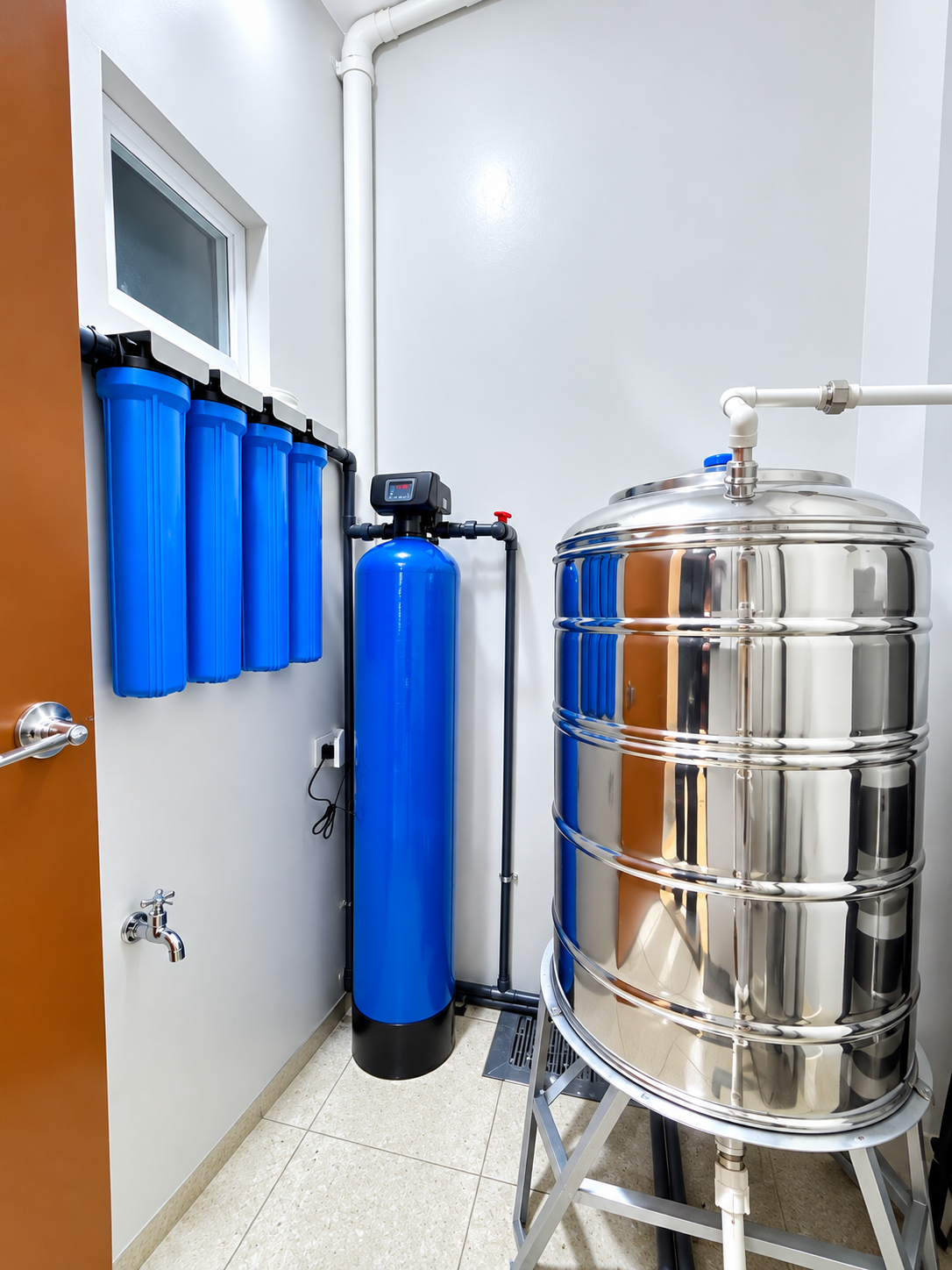
D. Multimedia and Activated Carbon Filtration
Multimedia filtration uses selected filtration media, often including graded quartz sand and other suitable materials, to reduce suspended solids and turbidity.
Activated carbon can be incorporated where appropriate to adsorb certain organic compounds, reduce chlorine and address some taste and odour concerns.
Depending on the source-water characteristics, a treatment train may include:
- Multimedia filtration vessels
- Quartz sand filtration
- Activated carbon filtration
- Automatic or manual backwashing
- Flow and pressure monitoring
- Cartridge filtration as a downstream polishing stage
Media type, vessel size, filtration velocity and backwashing requirements should be determined through water analysis and system design. Activated carbon does not remove every dissolved contaminant, and it can support microbial growth if poorly maintained.
E. Water Softening Systems
Water softening typically uses ion-exchange resin to replace calcium and magnesium ions with sodium or another suitable exchange ion.
Automatic water softeners commonly include a resin vessel, automatic control valve, brine tank and regeneration system.
Softening may be useful for:
- Hotel boilers and water heaters
- Commercial laundries
- Kitchens and dishwashing equipment
- Heat exchangers
- RO pretreatment
- Residential plumbing systems
Softening helps reduce hardness-related scaling but does not remove the overall dissolved salt content or make saline water fresh. It is not a replacement for reverse osmosis.
The suitability of sodium-cycle softening must also be assessed where sodium concentration is a concern, particularly for drinking-water applications.
F. Sediment and Cartridge Filtration
Sediment filtration is often an important preliminary stage in water-treatment systems.
PP sediment cartridges and industrial cartridge filters, including 20-inch configurations and suitable 5-micron or 1-micron elements, can capture suspended particles and protect downstream equipment.
Correct cartridge selection depends on particle loading, flow rate, filtration rating and allowable pressure drop. Differential pressure monitoring and timely replacement help maintain performance.
G. UV Disinfection and Chlorination
Disinfection is an essential component of many drinking-water treatment trains.
Ultraviolet treatment exposes water to UV radiation at a validated dose to inactivate susceptible microorganisms. UV does not remove dissolved salts, heavy metals or suspended particles and generally provides no continuing disinfectant residual in distribution.
Chlorination may be suitable where a residual disinfectant is needed to help protect water during storage and distribution. Its dosage, contact time, pH requirements and by-product risks must be appropriately managed.
Microbiological verification and hygienic storage remain important, regardless of the selected disinfection method.
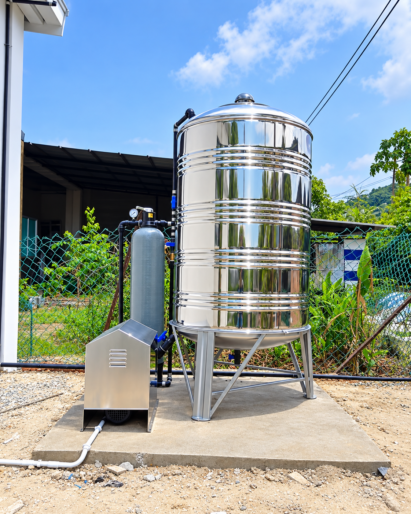
H. Stainless Steel and Hygienic Water Storage
Properly designed storage helps maintain the quality and reliability of treated water.
Food-grade SS304 stainless steel tanks may be suitable for some treated-water applications, provided the water chemistry and operating environment are compatible with the material.
However, chloride-rich or saline water may cause corrosion of SS304. Depending on the water chemistry, alternative materials such as suitable plastics, other stainless steel grades or engineered coatings may be more appropriate.
Storage design should consider tank capacity, covers, protected vents, drainage, cleaning access, inspection, overflow protection and hygienic distribution.
| Technology | Main function | Important limitation |
|---|---|---|
| Reverse osmosis | Reduces dissolved salts and many dissolved contaminants | Requires appropriate pretreatment and reject-water management |
| Seawater RO | Desalinates seawater | High-pressure operation and careful brine management |
| Ultrafiltration | Reduces suspended solids and many microorganisms | Does not remove dissolved salts |
| Multimedia filtration | Reduces turbidity and suspended particles | Does not independently desalinate water |
| Activated carbon | Adsorbs certain organics and reduces chlorine and some odours | Not a universal chemical-removal process |
| Water softening | Reduces calcium and magnesium hardness | Does not remove overall salinity |
| Cartridge filtration | Captures particles at a specified filtration rating | Requires routine cartridge replacement |
| UV disinfection | Inactivates susceptible microorganisms | No dissolved-salt removal or residual disinfection |
3. Engineered Water Treatment Solutions for Zanzibar’s Key Sectors
Every property has different water requirements. A residential villa, a 200-room beachfront resort and a commercial water-refilling operation should not automatically receive the same treatment configuration.
Luxury hotels and beachfront resorts
Hotels depend on reliable water for guest rooms, kitchens, laundry, housekeeping, pools and engineering facilities.
Where water quality is unsuitable, scaling, corrosion, staining, odour and inconsistent water characteristics may create maintenance and guest-experience concerns.
A hotel water-treatment design may combine multimedia filtration, softening, RO, UF, disinfection, treated-water storage and appropriately sized pumping and distribution systems.
The design should assess peak occupancy, daily consumption, kitchen requirements, laundry loads, hot-water systems and seasonal demand.
Your guests may never see the engineering behind your water system, but they experience its results every day.
Boutique hotels, guesthouses and Airbnb properties
Smaller hospitality properties may require compact, automated treatment systems that fit within limited plant-room space.
Depending on the water source, a configuration may include sediment filtration, activated carbon, softening, UV disinfection or a suitably sized RO system for drinking-water production.
Separate consideration should be given to potable water, bathrooms, laundry, kitchens and other non-potable applications.
Luxury villas and residential apartments
Private homes and residential developments may require whole-property water conditioning alongside dedicated drinking-water purification.
Possible solutions include automatic softeners, multimedia filtration, UV systems, under-sink RO units and central RO plants, depending on the source and water-use profile.
For apartment complexes, centralised treatment and storage can simplify monitoring and maintenance, while properly designed distribution protects water quality throughout the property.
Restaurants and commercial kitchens
Food preparation, dishwashing, ice production, beverages and hot-water equipment may require specific water-quality characteristics.
Treatment options may include sediment filtration, activated carbon, softening, RO and disinfection. The selected system should match equipment manufacturers’ water specifications and applicable food-safety requirements.
Schools, hospitals and institutions
Educational, healthcare and institutional facilities may have significant daily water demand and specific hygiene requirements.
Appropriate solutions may involve source-water pretreatment, RO where required, validated disinfection, protected storage, routine testing and clear operating procedures.
Healthcare applications may require additional specialised water-quality specifications depending on the medical equipment and intended use.
NGOs and community water projects
Community water infrastructure requires a balance between treatment performance, water availability, operating costs, maintainability and operator capacity.
System design should include water analysis, demand assessment, suitable treatment, hygienic storage, accessible consumables and practical training.
Commercial water-refilling stations
A water-refilling business requires a suitable treatment train, reliable production capacity, hygienic dispensing and storage, water-quality verification and compliance with applicable regulations.
A commercial RO system may be integrated with pretreatment, disinfection, product storage and dispensing equipment.
Production capacity, electricity consumption, reject-water volume, consumables and servicing requirements should be assessed before investment.
Industrial and real estate developments
Industrial and new construction projects may require water for process operations, staff consumption, cooling, cleaning, boilers or other specialised uses.
Treatment must be designed to meet the relevant process specifications, while allowing for future capacity, plant-room access, utilities, maintenance and expansion.
4. Water Testing: The Foundation of Precision Engineering
Do not invest in a water-treatment plant before understanding the water it is designed to treat.
BILLAFRICA recommends starting with a water-quality assessment and a clear understanding of the property’s water demand.
Depending on the source and intended application, the assessment may include:
- TDS and electrical conductivity
- pH and turbidity
- Total hardness and alkalinity
- Chloride and relevant major ions
- Iron and manganese
- Relevant scaling and corrosion indicators
- Microbiological parameters, including appropriate indicator organisms
- Other contaminants identified through source history or risk assessment
A qualified laboratory should perform the relevant tests, particularly where the results will be used to verify drinking-water safety.
Our engineering-led project approach
1. Initial consultation: Understand the project location, raw-water source, intended use, estimated demand and customer’s objectives.
2. Water analysis: Review laboratory results and identify the treatment requirements, including any additional tests needed.
3. Site assessment: Evaluate available space, access, source-water pumping, drainage, electrical supply, storage and installation conditions.
4. Engineering design: Determine the appropriate treatment train, equipment specifications, production capacity, automation and pretreatment.
5. Technical and commercial proposal: Present the proposed configuration, scope of supply, installation requirements, operating considerations and quotation.
6. Equipment supply and installation: Install the approved treatment equipment and integrate it with the site’s utilities and storage infrastructure.
7. Commissioning and verification: Test the operating system, review performance and verify treated-water quality against the intended specification.
8. Training and after-sales support: Provide operating guidance, maintenance schedules and information on consumables and replacement parts.
This approach helps customers understand what they are purchasing and why each treatment stage is included.
5. Why Precision Engineering Matters
Water treatment is not about selling filters. It is about engineering the right solution for your water.
An undersized plant may struggle to meet peak demand. An incorrectly selected membrane may fail to achieve the required product-water specification. Insufficient pretreatment can increase fouling and maintenance. Poorly selected construction materials may be vulnerable to corrosion.
Precision engineering addresses these risks by considering:
- Actual raw-water chemistry
- Required treated-water quality
- Daily and peak production demand
- Correct pretreatment and membrane protection
- Appropriate recovery and reject-water management
- Pump selection and electricity requirements
- Storage, distribution and pressure management
- Monitoring and automation
- Consumable availability and maintenance access
- Commissioning and performance verification
The objective is to provide a treatment system that is appropriate for its intended application and practical to operate over its service life.
6. Why Choose BILLAFRICA INTERNATIONAL INVESTMENTS LIMITED?
BILLAFRICA INTERNATIONAL INVESTMENTS LIMITED is a registered Tanzanian company providing water-treatment equipment and engineered water-purification solutions.
With its head office in Dar es Salaam and a Zanzibar branch on Thabiti Kombo Road, the company serves customers seeking residential, commercial and industrial water-treatment solutions.
Our solution areas include:
- Reverse osmosis and desalination systems
- Ultrafiltration membrane systems
- Multimedia and sediment filtration
- Automatic water-softening systems
- UV disinfection and integrated purification
- Commercial water-refilling solutions
- Water storage and distribution integration
- Equipment supply and installation
- Commissioning and technical support
- Preventive maintenance and consumables
Our engineering-led approach focuses on understanding the project before recommending equipment.
Whether you need a compact residential purifier, a commercial RO plant, a hotel water-treatment system, or a customised industrial installation, the first step is an assessment of your water quality and requirements.
BILLAFRICA INTERNATIONAL INVESTMENTS LIMITED
International Standards Water Solutions
7. Understanding the Investment Value and Total Cost of Ownership
The purchase price of a water-treatment plant is only one part of the total investment.
A complete project evaluation should consider:
| Cost component | What to consider |
|---|---|
| Capital expenditure | Treatment equipment, pumps, tanks, piping, controls and installation |
| Electricity | Pump power, operating hours and energy requirements |
| Consumables | Cartridges, chemicals, filter media and other replacement items |
| Membranes | Cleaning, performance monitoring and eventual replacement |
| Maintenance | Planned servicing, inspections and corrective repairs |
| Water recovery | Feedwater demand and the volume of reject or backwash water |
| Storage and pumping | Tank capacity, pump energy and pressure requirements |
| Monitoring | Laboratory testing, instrumentation and water-quality verification |
| Downtime | Maintenance planning, spare parts and operational continuity |
For hotels and resorts, a suitable system can support consistent water quality across kitchens, guest facilities, laundry and engineering equipment.
For commercial water-refilling businesses, the financial model should include saleable water output, production capacity, regulatory compliance, hygienic handling, maintenance and ongoing operating costs.
A site-specific financial assessment is preferable to relying on generic savings or payback claims.
8. Environmental Responsibility and Sustainable Water Treatment
Water-treatment infrastructure should be designed with consideration for Zanzibar’s groundwater resources and coastal environment.
Responsible engineering can include:
- Selecting appropriate recovery rates based on source-water chemistry
- Reducing avoidable water losses
- Choosing energy-efficient pumps where appropriate
- Optimising pretreatment to reduce unnecessary chemical use
- Managing backwash and reject streams responsibly
- Considering the effects of groundwater abstraction
- Planning maintenance to preserve system efficiency
- Incorporating storage and demand-management measures
For seawater desalination projects, intake design, concentrate discharge and potential effects on the marine environment require particular attention.
Discharge arrangements, groundwater abstraction and other relevant activities should be assessed against applicable environmental requirements, permits and regulatory obligations.
Sustainability does not mean selecting the highest recovery rate or the lowest-energy equipment in isolation. The treatment process must remain reliable, protect equipment and produce water that meets its intended specification.
9. Frequently Asked Questions About Water Treatment in Zanzibar
1. What is the best water-treatment system for Zanzibar?
There is no single system suitable for every water source in Zanzibar. The correct solution depends on salinity, hardness, turbidity, microbiological quality, daily demand and the intended use. Water analysis should guide the selection of RO, UF, softening, filtration, disinfection or a combination of technologies.
2. How can I purify salty borehole water in Zanzibar?
Salty borehole water may require brackish-water reverse osmosis or a specialised desalination configuration. The required operating pressure, membrane type, pretreatment, recovery and reject-water management depend on the measured salinity and complete water chemistry.
3. Can reverse osmosis remove salt from Zanzibar borehole water?
Yes. Properly designed RO systems can remove a substantial proportion of dissolved salts from suitable borehole water. Performance depends on the membrane, pressure, feedwater characteristics, temperature and operating conditions. The treated water should be tested to confirm it meets the required specification.
4. What is the difference between seawater desalination and brackish-water RO?
Brackish-water RO treats groundwater or other water sources with lower salinity than seawater. Seawater RO is designed for much higher salinity and generally requires higher pressure, specialised materials and specific pretreatment. Their equipment and operating requirements are not interchangeable.
5. How much does a commercial RO plant cost in Zanzibar?
The price depends on production capacity, raw-water quality, pretreatment requirements, membrane configuration, automation, materials, storage, installation and site conditions. A quotation should be based on the actual project scope and water analysis.
6. Which RO capacity is suitable for a hotel in Zanzibar?
The required capacity depends on the number of rooms, occupancy, staff, kitchens, laundry, other water-consuming facilities and the proportion of total demand that will be treated. A demand assessment and engineering design should establish the required production rate, storage and redundancy.
7. Can UF membranes make borehole water safe to drink?
UF can remove suspended solids and many microorganisms when properly specified, operated and validated. However, it does not remove dissolved salts or many dissolved chemical contaminants. Additional treatment and disinfection may be necessary to produce safe drinking water.
8. Does a water softener remove salt from water?
No. Conventional sodium-cycle water softeners exchange calcium and magnesium for sodium. They reduce hardness but do not remove the overall dissolved salt content. Reverse osmosis or another suitable desalination process is required where dissolved salinity needs to be reduced.
9. How can I treat hard water in Zanzibar?
Depending on the water chemistry and intended use, treatment may include ion-exchange softening, antiscalant dosing, RO or other suitable conditioning methods. Water analysis helps determine the appropriate option and its compatibility with plumbing and equipment.
10. Can BILLAFRICA supply and install water-treatment systems in Zanzibar?
BILLAFRICA INTERNATIONAL INVESTMENTS LIMITED provides water-treatment equipment and engineered purification solutions and has a Zanzibar branch at Thabiti Kombo Road. Contact the company to discuss your project location, site requirements, installation scope and technical support arrangements.
11. What water tests are required before installing an RO plant?
Testing may include TDS, conductivity, pH, turbidity, hardness, alkalinity, chloride, iron, manganese, relevant scaling indicators and microbiological parameters. Additional tests may be needed based on the source and intended application.
12. How often should RO membranes be replaced?
Membrane service life depends on feedwater quality, pretreatment, operating conditions, cleaning, system maintenance and manufacturer specifications. Replacement should be based on monitored performance, including normalised permeate flow, salt rejection and differential pressure, rather than a fixed assumption alone.
13. What is the difference between water filtration and water purification?
Filtration generally removes particles or specific substances according to the filter’s design. Purification is a broader term describing a treatment process intended to meet a defined water-quality specification. A complete purification system may combine filtration, membrane treatment, chemical conditioning and disinfection.
14. Can a water-treatment system supply an entire hotel or resort?
Yes, a suitably designed system can supply a hotel’s required treated-water demand, subject to source availability, plant capacity, storage, distribution, operating arrangements and water-quality requirements. Large properties may use multiple treatment trains, separate water-quality networks or backup arrangements.
15. How can hotels reduce scaling and corrosion in their water systems?
Scaling and corrosion should be managed by understanding the water chemistry and selecting appropriate treatment, materials and operating conditions. Softening, antiscalant dosing, pH conditioning or RO may be suitable in specific circumstances. Material selection should account for chloride levels and the operating environment.
16. Can BILLAFRICA design water-treatment systems for new construction projects?
BILLAFRICA can assess water-treatment requirements for proposed residential, commercial, hospitality and industrial developments. Early consultation helps integrate the treatment plant with plant-room space, power, plumbing, storage, drainage and future expansion requirements.
17. What maintenance does a commercial water-treatment plant require?
Maintenance may include cartridge replacement, media backwashing, softener regeneration, chemical replenishment, pump inspection, membrane monitoring, cleaning, disinfection, instrumentation checks and periodic laboratory testing. The actual schedule should follow the system design, water quality and equipment manufacturers’ instructions.
18. How can I start a commercial water-refilling business in Zanzibar?
Begin by assessing the intended market, source-water availability, water quality, production capacity, operating costs, premises and applicable regulatory requirements. The treatment plant should be designed around the desired output, verified water-quality specification, hygienic dispensing, storage and maintenance arrangements.
19. Is desalinated water suitable for drinking?
Desalinated water can be suitable for drinking when the complete treatment process is appropriately designed, operated and verified against the applicable drinking-water requirements. Post-treatment, such as remineralisation or disinfection, may be necessary depending on the water chemistry and distribution system.
20. How can I request a water-treatment project quotation from BILLAFRICA?
Contact BILLAFRICA by telephone, email or through its website. Provide the project location, raw-water source, available water-analysis results, required daily capacity, intended application and any site or installation information. This helps the team assess the project and prepare a relevant technical and commercial proposal.
10. Planning Water Treatment Projects Across Zanzibar
Water-treatment requirements may differ across Unguja, Pemba and individual coastal and inland locations.
Properties in Stone Town, Chukwani, Fumba, Nungwi, Kendwa, Matemwe, Kiwengwa, Pongwe, Uroa, Paje, Bwejuu, Jambiani and Michamvi may have different water sources, site conditions and infrastructure needs.
These locations should not be assumed to share identical groundwater quality or treatment requirements.
Whether you are constructing a beachfront resort, upgrading an existing hotel, developing residential apartments, establishing a commercial water-refilling operation or seeking a solution for borehole water, a site-specific assessment is the starting point.
Planning ahead also makes it possible to coordinate the treatment plant with architectural design, plumbing, electrical systems, water storage, drainage and maintenance access.
11. Planning a Water Treatment Project in Zanzibar?
Whether you are developing a luxury beachfront resort, managing a hotel, constructing residential apartments, operating a school, investing in a commercial water-refilling business or seeking a solution for salty borehole water, BILLAFRICA INTERNATIONAL INVESTMENTS LIMITED can help assess your water-treatment requirements.
Our team can discuss your raw-water source, water-quality results, daily demand, project location and technical requirements to help identify a suitable engineering solution.
Contact us to discuss:
- Water analysis consultation
- Borehole water purification
- Brackish-water RO and seawater desalination
- Commercial and industrial RO plants
- Ultrafiltration and multimedia filtration
- Water softening and integrated treatment systems
- Hotel and resort water-treatment projects
- Water storage and distribution
- Equipment supply, installation and commissioning
- Maintenance and technical support
BILLAFRICA INTERNATIONAL INVESTMENTS LIMITED
International Standards Water Solutions
Request a Water Analysis Consultation | Arrange a Site Assessment | Get a Tailored Engineering Proposal
Conclusion: Designed Around Your Water. Built Around Your Needs.
Reliable water infrastructure starts with understanding the water source, identifying the required quality and selecting the right treatment technology for the application.
For Zanzibar’s growing hospitality, residential, commercial, institutional and industrial sectors, properly engineered water-treatment systems can support operational reliability, equipment protection, hygienic storage and consistent water quality.
From borehole purification and water softening to reverse osmosis, ultrafiltration, commercial purification and seawater desalination, each project deserves a solution based on its actual technical and operational requirements.
BILLAFRICA INTERNATIONAL INVESTMENTS LIMITED is committed to an engineering-led approach that brings together water assessment, system selection, equipment supply, installation, commissioning and technical support.
